
Core Courses
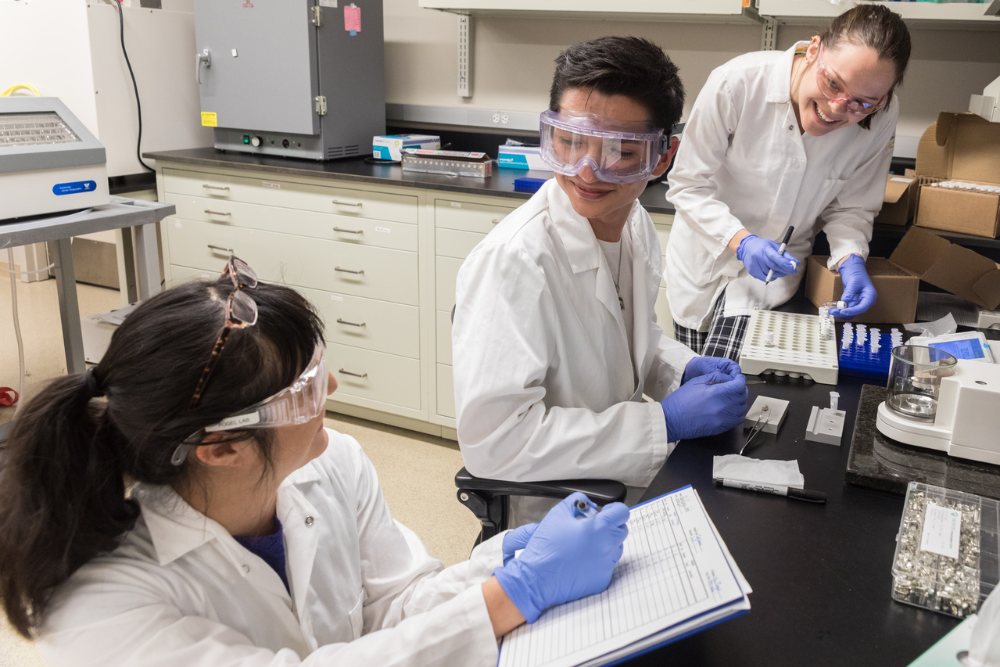
Students at work in Professor Sora Kim’s lab.
All LES graduate students complete a shared core sequence in their first two years. The core builds a common foundation across the program's three cornerstones and helps each entering class develop as a cohort.
- LES 200 – Fundamentals of Life and Environmental Sciences (3 units, Fall, Year 1): The three cornerstones through faculty lectures and journal discussions, plus an introduction to research skills such as literature review, experimental design, research ethics, and communication.
- LES 201 – Quantitative Methods in LES (3 units, Spring, offered in alternate years): Data management, R programming, statistical inference, linear models, multivariate and Bayesian statistics, model selection, reproducible coding, and data visualization. Another course that meets the quantitative requirement may be substituted with approval.
- LES 202 – Scientific Writing and Communication (3 units, Spring, Year 1): Writing manuscripts, grant proposals, and abstracts, and giving oral presentations. Students write their integrative paper in this course.
- LES 203 – Qualifying Exam Preparation (1 unit, Spring, Year 2; Ph.D. students only)
- LES 290 – Seminar (1 unit each semester)
- LES 295 – Graduate Research (1–12 units)
Electives
Students take two electives chosen around their research interests:
- LES 210 – Topics in Evolution of Life and Earth (3 units)
- LES 220 – Topics in Interactions (3 units)
- LES 230 – Topics in Flows & Transitions (3 units)
- LES 240 – Topics in Global Change & Sustainability (3 units)
With advisor approval, electives may also come from other UC Merced graduate programs (for example, Quantitative and Systems Biology or Environmental Systems) or from approved 100-level courses.
Specialized Courses Taught by LES Faculty
LES faculty also teach specialized graduate courses, offered under the LES Topics series or through ES and QSB, including Geochemistry, Biogeochemistry, Subsurface Hydrology, Global Change Biology, Ecosystem-Based Climate Solutions, Soil Organic Matter, Microbial Ecology, Environmental Modeling, Paleoecology, Ecological Genetics, Air Pollution, Phylogenetics, Biogeography, Community Ecology, Ecological Dynamics, Environmental Toxicity, and Advanced Stable Isotope Ecology.
Unit Requirements
Students complete 24 units of coursework: three 3-unit core courses, two 3-unit electives, and three 1-unit courses. At least 20 units must be at the 200 level, including LES 295 research units. Students are expected to enroll full-time every semester.
